You’re staring at a web design quote and wondering if a template would do the same job. It’s a fair question, and the honest answer is sometimes yes, sometimes no.
What makes the difference isn’t the price tag. It’s where your business is right now and how much work you need your website to do. This guide walks through what actually separates a custom site from a template, what each cost in Australia, and how to make the call without over-investing or selling yourself short.
What We Actually Mean by Custom Web Design
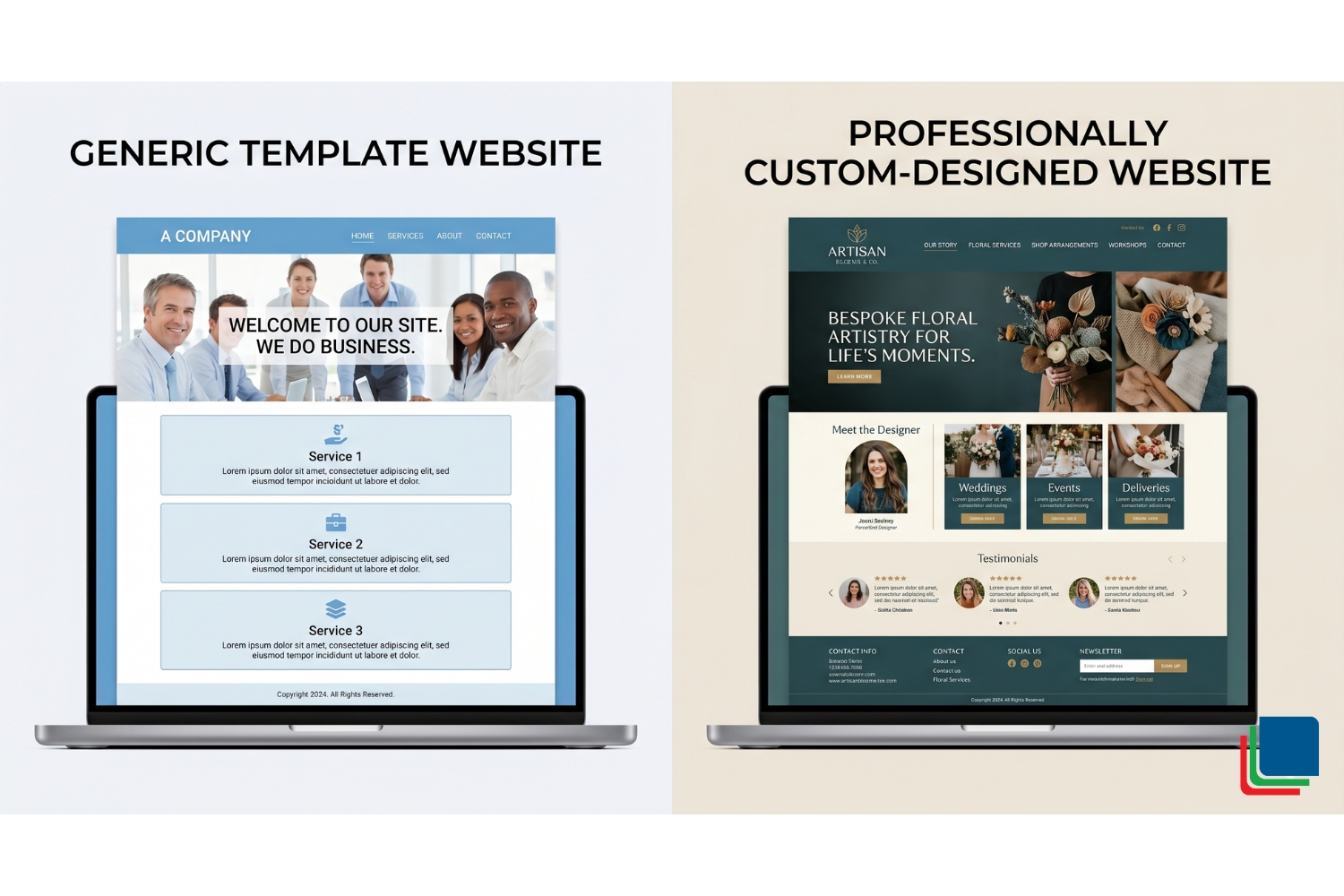
The term custom web design is used loosely in the industry, and it’s worth being precise about what it does and doesn’t mean before weighing it up as a decision. A custom website is one that has been designed and built specifically for your business, your audience, and your goals. The layout, visual language, user journey, and technical architecture are all shaped around what your customers need to see and do when they land on your site, rather than being pre-determined by a third-party template.
This is distinct from a template website, which uses a pre-built framework, whether through a platform like Wix, Squarespace, or Shopify, or through a purchased WordPress theme, and then fills in that framework with your brand assets and content. Templates are designed to serve as many different businesses as possible, which is exactly what makes them useful as a quick starting point and exactly what limits them when your business needs to express something specific or compete seriously in search.
It’s also worth acknowledging that there’s a spectrum between these two poles. A premium template with heavy customisation, modified structure, purpose-built pages, and a coherent design system applied throughout can sit much closer to a custom site than a template used straight out of the box. What matters is not the label but the outcome: does the site reflect your business clearly, does it perform well for your customers, and does it support the goals you have set for it?
| IMPORTANT DISTINCTION | A website that looks custom isn’t necessarily custom. Many agencies apply surface-level styling to a template and present it as a custom build. Genuine custom web design involves designing the user experience, page structure, and conversion flow specifically for your audience, not just adding your logo and brand colours to someone else’s layout. |
What a Template Website Gets Right
Templates have earned their popularity for good reasons, and it’d be dishonest to dismiss them. For many small businesses at certain stages of growth, a well-chosen and properly set-up template website is exactly the right decision. Understanding where templates genuinely excel helps you assess whether that applies to your situation.
Speed to market
A template website can be live in days or weeks. For a new business that needs an online presence immediately, a seasonal campaign that needs a landing page quickly, or a business that is testing a new service before committing to full development, this speed is genuinely valuable. The ability to go from nothing to published within a short timeframe is something a custom build can’t match.
Lower upfront investment
Template websites typically cost between a few hundred and a few thousand dollars to set up, depending on whether you do it yourself or engage a designer to configure it for you. For a business that is still validating its model, managing cash flow carefully, or operating in a market where the website isn’t a primary revenue driver, keeping that cost low is a legitimate priority. The money saved can fund other parts of the business more effectively than a premium website investment.
Ease of self-management
Platforms like Wix, Squarespace, and well-configured WordPress installations give business owners a visual editing interface that makes updating content, adding images, and changing text straightforward without developer assistance. For small businesses where the owner wears many hats and updates their own content regularly, this self-service capability reduces ongoing costs and dependency on third parties.
Sufficient for simpler goals
If your website’s primary role is to confirm your business exists, provide contact information, give a brief overview of your services, and support a Google Business Profile, a well-executed template site fulfils that role adequately. For many trades, local service businesses, and brick-and-mortar retailers where most customer relationships begin through referral or foot traffic rather than online search, this is a perfectly reasonable position to be in.
| HONEST ASSESSMENT | Templates work well when the website is a supporting presence rather than a primary growth channel. If your business would survive and grow without the website doing heavy lifting, a template gets you online without over-investing. The question to ask is whether that’s true for your business. |
Where Templates Start to Hold Your Business Back
The genuine limitations of template websites rarely show up immediately. They accumulate over time as your business grows, as you try to do more with the site, and as competition in your market intensifies. Understanding where those limitations appear helps you judge whether you’re approaching them now or are still some distance away.
Your brand looks like everyone else’s
Templates are designed to appeal to the widest possible range of businesses. This means they tend toward generic layouts, predictable structures, and visual patterns that are recognisable to anyone who has spent time on the web. When a prospective customer lands on your website, one of the things they are unconsciously evaluating is whether your business feels distinct and trustworthy. A template that they’ve seen dozens of variations of across your industry gives them no particular reason to choose you over a competitor. Research consistently shows that 94 per cent of first impressions are design-related, and that users form judgements about a website in under 50 milliseconds. The visual language of your site is communicating before a single word has been read.
The user journey is built for anyone, not your customer
Every business has a specific type of customer who arrives with a specific set of questions and a specific path to becoming a paying client. A plumber’s website needs to make it effortless to call in an emergency. A wedding photographer’s website needs to build emotional trust quickly and guide visitors toward a booking consultation. A specialist professional services firm needs to establish credentials and create a natural path to an enquiry. Template layouts are built around a generic visitor journey that may not match any of these with enough precision. Custom design allows you to map the actual decision-making process of your specific customer and build a website that supports it at every step, which is what separates a site that generates enquiries from one that gets traffic without converting it.
Performance and code bloat
Templates are built to accommodate the widest possible range of use cases, which means they contain code, scripts, and features that your business will never use. This code bloat isn’t visible to visitors, but it adds load to every page and slows down the site. According to Google, 53 per cent of mobile visitors abandon a site if it takes longer than three seconds to load. Template platforms compound this with platform-level scripts and third-party plugin dependencies that accumulate over time, each adding marginal load to every page visit. Custom websites can be built with only the code they need, resulting in faster load times, better Core Web Vitals scores, and measurable advantages in both search ranking and user engagement.
SEO limitations
Template platforms routinely describe themselves as SEO-friendly, and in the sense that they produce pages that search engines can technically index, this is accurate. What it doesn’t mean is that they provide the level of technical SEO control that serious competition for search traffic requires. Custom websites allow precise control over page structure, heading hierarchy, schema markup, internal linking architecture, canonical tags, URL structures, and page speed optimisation, all of which matter for ranking in competitive local and national searches. For an Australian small business investing in content and organic traffic, the technical foundation of the website determines how well that investment performs.
For more on how website structure affects your search visibility, our SEO and web design page explains how we integrate search performance into every website we build from the design stage.
Scalability and the rebuild problem
Perhaps the most expensive limitation of template websites isn’t immediately apparent: what happens when you outgrow them. Businesses that launch on a template often find themselves, two or three years later, wanting to add functionality, restructure their service offering, integrate booking or ecommerce systems, or redesign significantly to reflect a more evolved brand. At that point they face a choice between forcing their new requirements into a framework that wasn’t designed for them or rebuilding the site from scratch and losing all the SEO equity they’ve accumulated. A custom website is designed with future evolution in mind, allowing new pages, features, and integrations to be added without structural compromises.
| THE REAL COST OF CHEAP | A template website that limits your enquiry conversion rate by even one per cent represents a real financial cost that compounds every month. If your site receives 500 visitors a month and converts at two per cent, you receive ten enquiries. A custom site that converts at three per cent delivers fifteen enquiries from the same traffic. Over a year, that difference is sixty additional enquiries. The question is whether those enquiries, valued at your average client lifetime value, justify the investment in a better site. |
What Custom Web Design Actually Costs in Australia
Cost is the most common reason Australian small businesses default to templates, and it’s important to address it with real numbers rather than evasive generalities. The honest picture is that custom web design in Australia spans a very wide range depending on who builds it, what it needs to do, and what level of strategic input is included.
At the lower end, a custom website for a small service business, typically five to ten pages, no ecommerce, a contact form and a blog, built by an experienced independent designer or small agency, is likely to sit in the range of three thousand to six thousand dollars. A more involved project with additional functionality, a more complex design system, content strategy, and SEO-ready architecture would typically range from six thousand to fifteen thousand dollars. Larger projects with ecommerce, booking integrations, membership areas, or multi-location service businesses naturally sit higher again.
Template websites, by contrast, can cost anywhere from nothing if you build them yourself through Wix or Squarespace, to between one thousand and three thousand dollars if you engage a designer to configure and populate a template professionally. The gap in upfront cost is real.
The more useful comparison, however, is total cost of ownership over three to five years, accounting for what the website does for your business. A template site that requires a redesign or migration after two years because it has become restrictive, or one that generates minimal enquiries because its conversion experience is generic, represents a different financial outcome than a custom site that compounds its value through better rankings, higher conversion rates, and increasing return on your marketing spend. The upfront cost is a real number; the long-term comparison is what justifies the decision either way.
| FOR BUDGET-CONSCIOUS BUSINESSES | If a full custom website isn’t the right investment for where your business is right now, a middle path exists. A professionally configured premium template, set up with strategic content, clear calls to action, and proper on-page SEO, outperforms a neglected custom site every time. The goal is not custom for its own sake but a website that genuinely works for your business at your current investment level. |
The Signs That Custom Is the Right Investment for You
Rather than a blanket recommendation, the most useful guidance is a set of indicators that your business has reached the point where a custom website is a sound investment rather than a luxury.
- Your website is a primary source of new enquiries or bookings, and you know that improving its performance would have a measurable effect on revenue.
- You’re competing against other businesses in search results, and your current site isn’t ranking for the terms your customers use to find services like yours.
- Visitors are coming to your site but not contacting you, which suggests the user experience or conversion pathway isn’t working as effectively as it should.
- Your brand has evolved and your current website no longer reflects the quality, professionalism, or positioning of your business as it is today.
- You want to add functionality such as online booking, ecommerce, client portals, calculators, or specific integrations that your current template can’t accommodate cleanly.
- You’re spending money on Google Ads or social media advertising, and the traffic is landing on a site that doesn’t convert at the rate it should, meaning your advertising cost per lead is higher than it needs to be.
- You operate in a competitive local or national market where the quality of your digital presence directly influences trust and purchasing decisions.
- You want to own your website outright rather than being dependent on a platform that could change its pricing, terms, or capabilities at any time.
| FOR ESTABLISHED BUSINESSES | A useful way to frame the decision is to ask what one additional client per month is worth to your business over a year. If your average client lifetime value is two thousand dollars and a better website generated one extra client per month, that’s twenty-four thousand dollars in annual revenue. Against that figure, a six-thousand-dollar website investment is a straightforward commercial decision, not a discretionary expense. |

The Signs That a Template Is the Right Call Right Now
Custom web design isn’t always the right answer, and pretending otherwise wouldn’t be serving Australian small business owners honestly. There are real situations where a template website isn’t just a compromise but the genuinely smart decision.
If your business is brand new and you’re still testing whether your service or product has a viable market, investing heavily in a custom website before you have validated the business model is putting the cart before the horse. A clean, professionally configured template lets you get online, test your messaging, and learn what your customers respond to before committing to the cost of a custom build.
If your primary customer acquisition comes through referral, word of mouth, trade relationships, or face-to-face sales, and the website functions mainly as a place for prospects to verify your credibility after they have already heard about you, a simple, well-presented template site fulfils that role without over-engineering it.
If you are in a sector with low digital competition, where your local area has few comparable businesses competing for online attention, the investment in custom design may not be justified by the marginal advantage it’d provide. A template that’s well-maintained, loads quickly, and presents your business clearly may be all you need to capture the available search traffic in your area.
If budget is a genuine constraint and the alternative to a template is no website at all, a template is always the better option. An imperfect online presence beats no online presence, and the right time to upgrade to custom is when the business can support that investment from a position of strength rather than strain.
Template vs Custom Designs
The table below provides a practical decision framework across the most common factors Australian small business owners consider when making this choice.
| Your situation | Template may be suitable | Custom design is worth it |
| Budget | Under $2,000 and need to launch fast | Ready to invest $3,000 to $10,000+ in a long-term asset |
| Timeline | Need to be live within days or a few weeks | Can allow 4 to 10 weeks for a properly built site |
| Business stage | Testing a new idea or just getting online for the first time | Established or growing business where the website drives enquiries |
| Brand differentiation | Your industry is low-competition or visual identity isn’t a priority | Your business needs to stand out clearly from local or national competitors |
| Functionality needs | Standard pages: home, about, services, contact, blog | Bookings, custom forms, ecommerce, calculators, integrations, or member areas |
| SEO ambition | Local presence, simple keyword targets, Google Maps listing | Competing for high-value search terms, need technical SEO built in from day one |
| Growth plans | Site is unlikely to change significantly in the next 3 years | Business is scaling, adding services, or requires the site to evolve continuously |
| Ownership | Comfortable with a platform like Wix, Squarespace, or WordPress | Want to own the code and not be tied to a third-party platform’s ecosystem |
What to Look for When Choosing a Custom Web Design Partner
If you decide that a custom website is the right investment, the quality of the outcome depends enormously on who builds it. The Australian web design market includes everything from offshore production services producing templated builds sold as custom, through to experienced independent designers and established agencies who genuinely work from your business goals outward.
Look for strategic thinking, not just visual work
A web design partner worth engaging should ask about your customers before they ask about your preferences. They should want to understand your sales process, your most valuable service or product, what a typical customer journey looks like, and what success means for the website in commercial terms. A designer who leads with mood boards and colour options before understanding what the site needs to achieve is building something that looks nice rather than something that works.
Verify that performance is built in, not bolted on
Ask specifically about how they approach page speed, mobile optimisation, and Core Web Vitals. Ask whether SEO considerations are part of the design and build process or something that gets addressed after launch. Ask about the content management system they use and whether you’ll be able to update the site independently after it is delivered. These questions separate practitioners who build websites as a craft from those who treat it as a transactional service.
Check who owns the result
Some agencies build on proprietary platforms that give the client access to edit the site but not to own or move the underlying code. This creates a dependency that can become expensive over time. For a small business making a meaningful investment in their digital presence, owning the website outright, with the code and hosting sitting under their own control rather than a third-party’s platform, is an important protection of that investment.
At Jez North Web, every project starts with your business goals rather than a template brief. To see the approach, we take and the kinds of businesses we have worked with, visit our portfolio and case studies page.
| OUR HONEST POSITION | We build custom websites for Australian small businesses, so we’ve an obvious interest in making the case for them. What we tell every prospective client is the same thing we’ve said throughout this guide: custom design is a sound investment when your website is a meaningful part of how you grow. When it isn’t at that stage yet, a well-configured template is the right call, and we we’ll tell you so. |
| WONDERING IF CUSTOM IS RIGHT FOR YOUR BUSINESS? We give every Australian small business owner a straight answer, not a sales pitch. Tell us about your business and we’ll tell you honestly whether a custom website makes financial sense for where you’re right now. Start the conversation at jeznorthweb.com.au/contact |